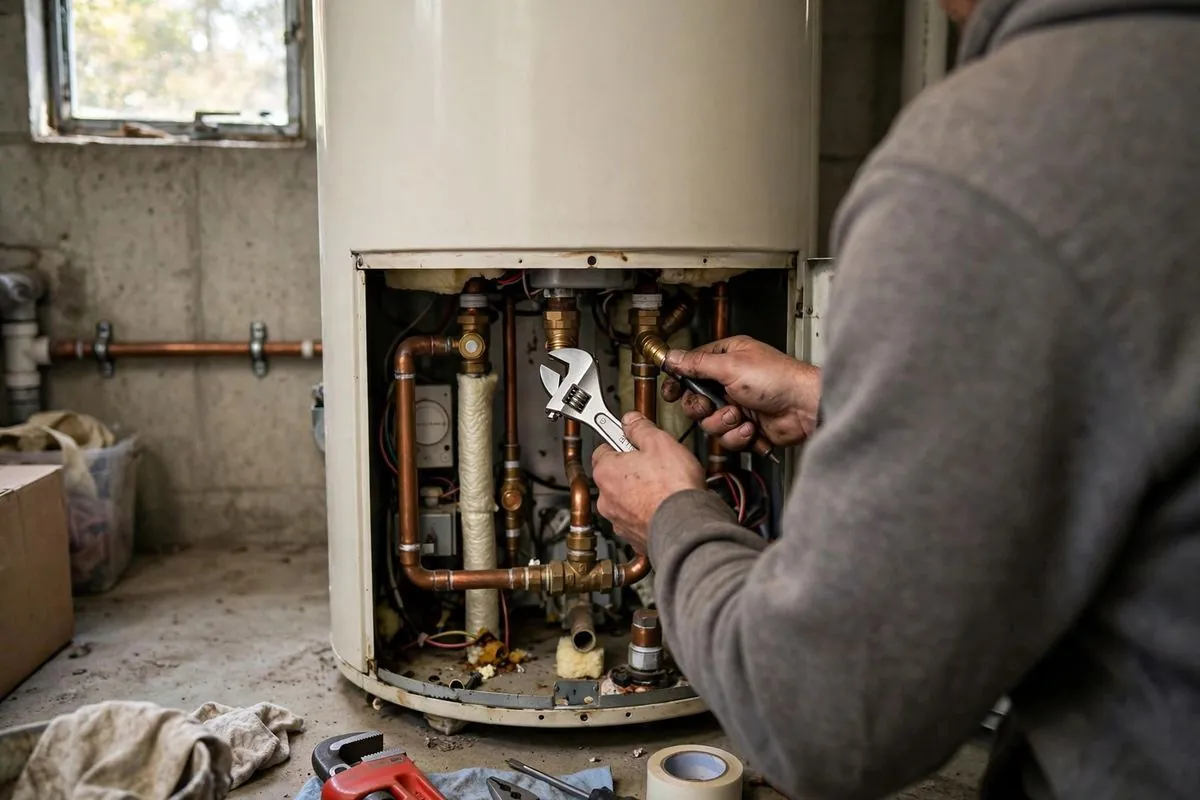
Water on the floor around your tank gets worse by the hour. Emergency water heater repair in Morton Grove, IL is a service where a licensed plumber stops the leak, restores hot water and makes the heater safe to run again. Calls are answered around the clock, and a same-day visit is booked whenever the schedule has room. Until the plumber gets there, shut the cold supply valve above the tank and switch off the power or gas control.
Signs your water heater needs attention
- Water pooling at the base or running down the side of the tank
- Dripping from the pipes or connectors on top
- Rust-colored water from the hot tap only
- Rumbling, popping or ticking from inside the tank
- Hot water that runs out within a few minutes
- A pilot light that keeps going out, or a burner flame that looks weak and yellow
- Steady water from the pipe attached to the relief valve
When a leaking water heater is an emergency
A slow weep from a fitting can wait for a morning appointment. Water running from the tank seam or pouring out of the relief valve pipe is an active failure, and it will not stop on its own. If the water is spreading across a finished floor, toward a floor drain or near the electrical panel, treat it as urgent and call at any hour.
A heater that gives out at 2 a.m. in January leaves a household with no hot water and sometimes a wet basement. Night and weekend calls go to the same dispatch line as daytime calls. The plumber deals with the water first and the hot water second.
What to do while you wait
- Find the shutoff on the cold pipe entering the top of the tank and turn the handle fully closed. A stopped supply keeps the leak from refilling.
- Gas heater: rotate the control knob to off. Electric heater: flip its breaker off, but only when the floor around the panel is dry and the panel is easy to reach.
- A rotten-egg smell means everyone goes outside. From there, phone 911 and the gas emergency line printed on your Nicor Gas statement, and leave light switches alone.
- If water is touching outlets, cords or the panel, stay clear and tell the dispatcher.
- Keep children and pets out of the water. Water from a failed tank can scald.
Tank leak or fitting leak: how to tell
Plumbers sort leaks into two groups, and the group decides the whole job. Fitting leaks come from supply connectors, the drain valve, the relief valve or the heating element gasket. Tank leaks come from inside the steel shell after corrosion has eaten through it.
| Where the water shows up | Likely source | Repairable? | Your next move |
|---|---|---|---|
| Drips from pipes on top | Supply connector or fitting | Usually yes | Close the cold valve and call |
| Beads of water at the drain valve | Worn drain valve | Yes | Leave the valve alone and call |
| Steady flow from the relief valve pipe | Pressure or temperature fault | Often | Turn the heater off and call |
| Water at the element panel on an electric unit | Failed element gasket | Yes | Switch power off and call |
| Seepage from the jacket or the bottom | Corroded tank | No | Plan for replacement |
Dry every wet spot with a towel, wait ten minutes, then watch where the first bead of water returns. Water that comes back from underneath the jacket almost always means the tank has failed. If the puddle does not match any spot above, the water may be coming from a hidden line nearby, and leak detection can trace it with acoustic listening and a moisture meter.
Gas, electric and hybrid heaters fail in different ways
The fuel type tells the plumber where to look first. The same symptom, no hot water, can come from three very different faults.
Gas heaters: pilot, thermocouple and burner
A gas heater keeps a small flame or an electronic igniter lit. The thermocouple is a probe sitting in that flame, and it tells the gas valve the flame is on. When the probe wears out, the valve shuts the gas and the pilot goes dark. The plumber tests it, cleans the burner and checks the vent draft.
Nicor Gas serves Morton Grove, so any gas smell goes to 911 and the utility's emergency number before anything else.
Electric heaters: elements and thermostats
An electric tank has an upper and a lower heating element, each with its own thermostat. A dead upper element means no hot water at all. A dead lower element means hot water that runs out fast, which is the most common complaint. The plumber tests each part with a meter, so the answer comes in minutes.
Heat pump hybrids
A hybrid heater adds a compressor and fan on top of an electric tank. It has more ways to fail, such as a clogged condensate drain, a dirty air filter or a sensor fault. Many hybrids fall back to their electric elements when the heat pump stops, so the tank still makes warm water while the top section sits idle. Parts supply varies by manufacturer, and the plumber will say plainly whether repair is sensible.
Why sediment and the anode rod decide how long a tank lasts
Morton Grove tap water comes from Evanston, and that city's 2023 report puts average hardness near 136 mg/L, or roughly 8.0 grains per gallon. The water is moderately hard. Dissolved minerals settle out as sediment on the tank floor, right where the burner or lower element does its work. Sediment causes the rumbling, wastes fuel and overheats the steel under it. On a Morton Grove tank, a yearly flush is worth doing.
The anode rod is a sacrificial metal rod that corrodes so the tank steel does not. Once it is gone, the shell starts to rust. Checking the rod during a repair visit tells the plumber how much life is left, and that feeds the repair-or-replace answer. If scale keeps coming back, a water softener is an option, though at this hardness it is a choice and not a requirement.
No hot water, or water that never gets hot
Total loss of hot water usually means the heater lost power, lost its flame or lost an element. Check the breaker, or look for a lit pilot on a gas unit, and press the red reset button once if your model has one.
If the breaker trips again or the pilot will not stay lit, stop and call, because repeated resets can hide a wiring or gas fault. Lukewarm water points to a failed lower element, a cracked dip tube that mixes cold water in, or heavy sediment.
Hot water gone or a tank leaking?
Dispatch answers day and night.
What the plumber does on a repair visit
A typical water heater repair visit
- 1Make it safeThe plumber shuts off gas or power and the cold supply, then checks for gas leaks and wet wiring.
- 2Find the sourceThe tank is dried and the water is traced to a fitting, a valve or the shell.
- 3Test the partsThermostats, elements, the thermocouple, the relief valve and the anode rod are checked as they apply.
- 4Set out the optionsYou hear the findings and a clear price before work starts.
- 5Repair and testThe part is replaced, the tank is refilled and purged of air, and the heater runs a full cycle while the plumber watches for drips.
What moves the price of a water heater repair
What changes the cost of a repair
- The failed part: A thermostat, an element, a relief valve and a gas control valve differ widely in part cost and labor.
- Tank age and condition: A heater with a corroded shell or a spent anode rod may not be worth a new part.
- Fuel type: Gas units add venting and combustion checks that electric units skip.
- Access: A tank in a tight closet or at the bottom of a steep basement stair takes longer to work on.
- Parts on hand: A part the plumber carries can be fitted in one visit, while a special order adds a second trip.
Homeowners insurance often covers sudden water damage from a failed heater, but it usually does not pay for the heater itself, and wear is typically excluded. Photograph the damage before cleanup and read your policy before you call the carrier.
Want your real number? Call (847) 281-8626.
Repair or replace: where the line sits
A tank that leaks through the shell cannot be patched, so repair stops there. A heater well past its first decade that needs a major part is a close call, because the next failure is likely to follow soon after. When the numbers favor a new unit, see water heater replacement for how the swap works. Some households use the moment to move to a tankless water heater, which has its own costs and trade-offs.
Repair crews cover the whole village and the neighboring towns, including Niles, with the same after-hours dispatch line.
Morton Grove note
Water heaters are on the village's list of work that needs a permit, and the application can be filed online. A small part swap, such as a new element or thermostat, may be treated differently from a full tank change. The village building office at (847) 470-5214 can tell you which category your repair falls in. A good plumber raises the question before touching the tank.
Illinois law says a person who repairs plumbing must hold a licence. Before the tank is opened up, look the plumber up in the licence lookup that IDPH runs for the public.
Source type: Village of Morton Grove permit list for water heaters
Frequently asked questions
Yes. Nights, weekends and holidays go through the same dispatch line as weekdays. A same-day slot is offered when one is open, though no arrival time is promised. Meanwhile, stop the cold water entering the tank and cut its power or gas, which gives the plumber a dry, safe start.
Dry the area, wait ten minutes and watch where water first returns. Water at pipes, valves or connectors is often a repairable fitting. Water from under the jacket or the bottom of the tank usually means the shell has failed.
No. Turn off the power or gas and close the cold supply until a plumber has looked at it. A tank that is leaking can fail all at once, and wet wiring on an electric unit is a shock risk.
Sediment on the tank floor traps steam bubbles that burst as the burner or element heats. Water supplied through Evanston is moderately hard, so scale builds over time. A flush often quiets the tank, but a heavily scaled tank may be near the end of its life.
Water heaters are on the village's permit list. Whether a single-part repair counts is a question for the village building office at (847) 470-5214, and your plumber should have the answer before starting.
It reduces scale a great deal, but it is not required at the hardness shown in Evanston's report. A yearly flush and a working anode rod do much of the same protective work.