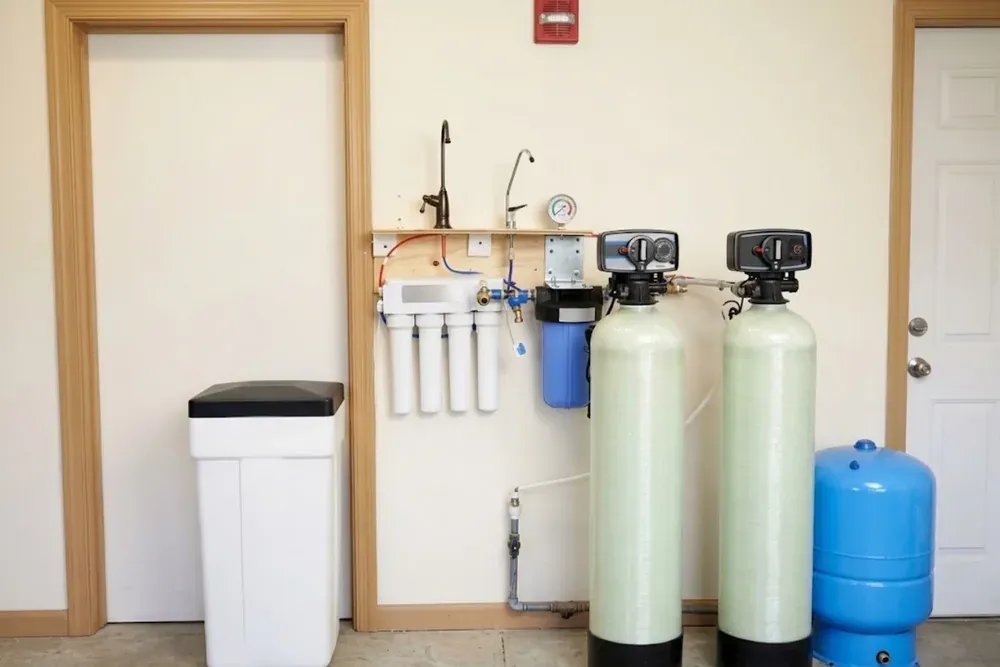
Water softener installation in Morton Grove, IL means fitting a tank-style unit on your main water line that swaps hardness minerals for sodium or potassium, so the water leaves less scale behind. Morton Grove water is moderately hard, not extreme, so a softener helps with scale but is not a necessity. A plumber can help you decide whether it fits your house, then connect it with a bypass, a proper drain and a salt supply.
Signs of hard water at home
- White or chalky crust around faucets and showerheads
- Spots on glasses and dishes after the dishwasher runs
- Soap that lathers poorly and leaves a film
- Laundry that feels stiff or looks dull
- Scale inside the kettle or around the coffee maker
- Sediment or rumbling in the water heater
What Morton Grove's tap water actually contains
Nothing in your tap is treated by the village itself. The water is Lake Michigan water that Evanston treats and chlorinates, and it reaches Morton Grove by way of the shared Morton Grove/Niles commission. In its 2023 report, Evanston gives average hardness as 136 mg/L expressed as calcium carbonate. The range runs from 124 to 152, which works out to roughly 8 grains per gallon, and the average pH is 7.6.
That puts the water in the moderately hard band. You will see spots and some scale, and your heater collects sediment over time, but nothing here makes a softener essential. If scale is your main annoyance, a softener works. If you mostly dislike the taste of chlorine, it will not help, and a carbon filter is the better tool.
Softener, filter or neither: choosing by problem
The right equipment depends on what you want to change. Hardness, taste and lead are three separate problems with three different tools.
| Your concern | Best fit | Not a fit |
|---|---|---|
| Scale on fixtures, spots, stiff laundry | Salt-based softener | A simple carbon filter |
| Chlorine taste and smell | Carbon filter at the tap or whole house | A softener |
| Lead at the tap | ANSI-certified filter on the drinking tap | A softener |
| Moderate hardness, low annoyance | Do nothing, flush the water heater yearly | Buying equipment for its own sake |
| Scale only in the water heater | Annual tank flush, anode rod check | A whole-house system |
Sodium is worth a note. A softener adds a small amount of sodium to the water, and people on sodium-restricted diets should ask a doctor first. Many households keep one unsoftened cold tap for drinking.
Lead and your tap: use a filter, not a softener
The Village of Morton Grove's 2025 Consumer Confidence Report covers lead in detail. Lead testing in 2024 found a 90th percentile of 12.4 ppb, and 3 sample sites were over the 15 ppb action level. Its advice is to let the tap run a few minutes ahead of a drink, and to choose a filter certified to the ANSI standard for lead reduction.
A softener is not designed to remove lead, so do not buy one for that purpose. An online inventory kept by the village lists the service line material for each address, and Public Works at (847) 470-5235 can answer questions. The EPA Safe Drinking Water Hotline is 1-800-426-4791. If your service line needs work, water line repair is the related service.
Weighing a softener for your house?
Call and ask about your plumbing.
What a softener installation involves
A softener installation
- 1Choose the spotThe unit goes near the main shutoff, with a drain, an outlet and floor space for the brine tank.
- 2Shut off and cut inThe plumber shuts the main supply and cuts into the line to add inlet, outlet and a bypass valve.
- 3Connect the drainA drain line with an air gap sends the regeneration water to a floor drain or standpipe.
- 4Add salt and programThe brine tank gets salt, and the head is set for your household's hardness and water use.
- 5Regenerate and testA first regeneration cycle runs, the joints are checked for leaks and hardness is tested at the tap.
Placement matters. The softener should sit after the main shutoff and before the water heater, and outdoor hose bibs are often left on unsoftened water. Whether your installation needs a permit is a question for the village building office at (847) 470-5214, since permits are required for sewer and water line repairs and for moving fixtures.
Softened water and your water heater
Scale builds on the bottom of a tank heater and coats the heat exchanger in a tankless unit. A softener cuts both. If you already have a sediment problem, a water heater repair visit can flush the tank, check the anode rod and tell you whether the heater has life left. Owners of tankless units get the biggest benefit, and the tankless water heater page explains the flush schedule.
Softener and water conditioner problems
Softeners fail in a few predictable ways. A salt bridge forms when a hard crust blocks the salt from dissolving, so the brine tank looks full but the unit stops softening. A worn resin bed, a stuck valve or a clogged injector can also bring hardness back.
If scale returns, check for a bridge by pushing a broom handle into the salt. Call a plumber if the hardness stays the same. Conditioners that use no salt reduce scale differently and have few moving parts, but they do not soften water in the same sense.
What moves the price of a softener installation
What changes the cost of an installation
- Unit size and type: A bigger household needs a larger resin tank and more capacity.
- Location and plumbing access: A long run to the drain or an awkward main line adds labor.
- Bypass and shutoff work: Old valves that no longer hold may need replacement.
- Electrical and drain: An outlet or a new standpipe adds time.
- Extras: A carbon filter or a drinking water filter adds equipment and labor.
A softener is elective equipment and not storm or leak damage, so a home policy will not pay for one. Keep the manual and the installer's invoice. The clear price should be in your hands before any work begins.
Want your real number? Call (847) 281-8626.
Morton Grove note
The village's 2025 Consumer Confidence Report gives chlorine as 1.0 ppm at its highest, within a span of 0.6 to 1.0 ppm, added to control microbes. Hardness is not in the village report at all, because Evanston treats the lake water and publishes that figure in its own 2023 report. A test of your own tap is the surest guide, since hardness moves between 124 and 152 mg/L through the year. Test your tap before you buy.
Source type: Morton Grove's 2025 water quality report together with Evanston's 2023 water report
Neighbors in Niles share the commission's name too, because its title covers both villages.
Frequently asked questions
No. The water Evanston supplies is moderately hard, near 8 grains in a gallon. A softener cuts scale and spotting, but many homes do fine without one.
No. For lead, the village report points to running the tap for a few minutes before drinking and to a filter with ANSI certification. A softener is not built for that job.
Softening adds a small amount of sodium. Many households keep one unsoftened cold tap, and anyone on a sodium-restricted diet should ask a doctor.
Test your tap with a hardness kit or a lab test. Evanston's report gives a range of 124 to 152 mg/L, but plumbing and timing can change what you see at your faucet.
Permits are required in the village for sewer and water line repairs and for fixture relocation. A softener may or may not count, so the village building office at (847) 470-5214 is the place to confirm.
Yes. Someone answers at every hour, and a same-day appointment is offered when the schedule allows. A leaking connection at the unit should be shut off at the bypass or main valve while you wait.