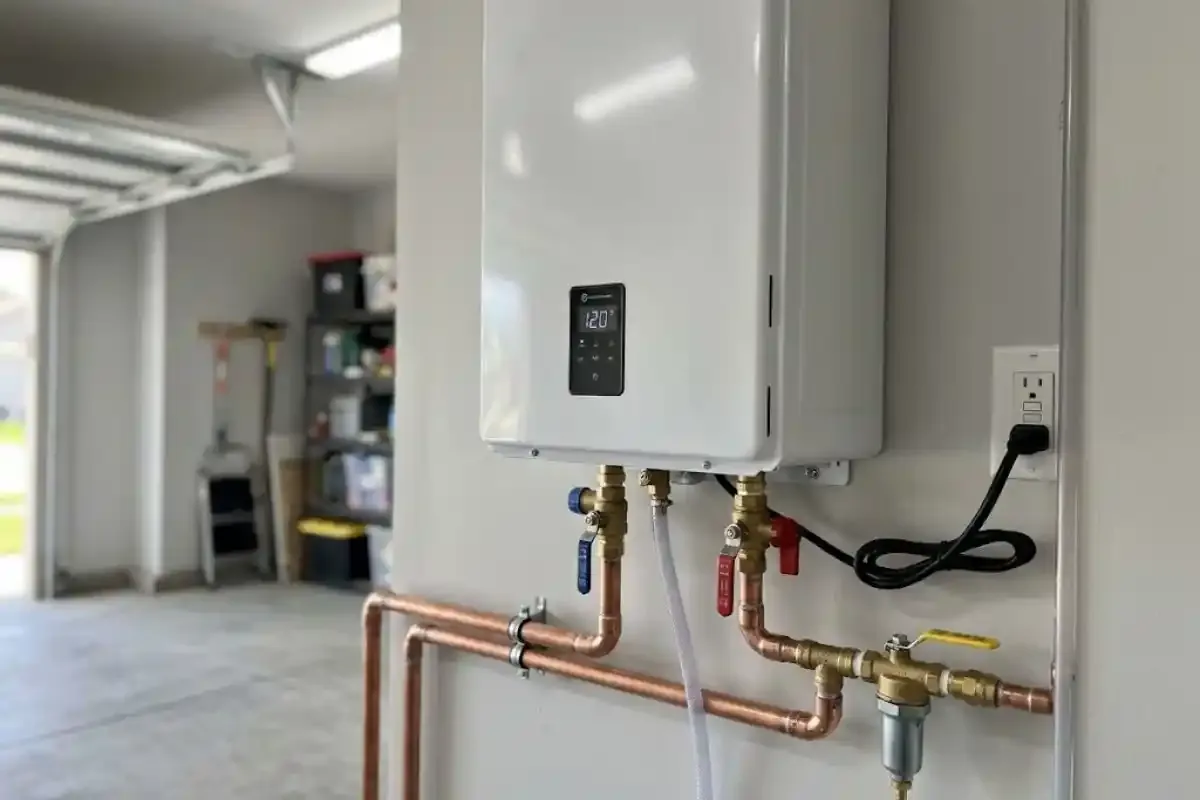
A tankless water heater is a wall-mounted unit that heats water on demand instead of storing it in a tank. When you open a hot tap, flow through the unit switches on a gas burner or electric element, and the water is heated as it passes through. For Morton Grove, IL homes, the main questions are whether the gas line is big enough, where the vent can run, and how much hot water you need at once.
This guide covers how the unit works, what it does well, where it falls short, and what keeps it running. If you want a plumber to look at your own setup, call (847) 281-8626. Calls are answered at every hour, and a same-day appointment is offered when the schedule has an opening.
How a tankless unit makes hot water
Inside the cabinet is a heat exchanger, which is a set of metal passages wrapped around a burner. Cold water enters at the bottom. A flow sensor notices the movement, the control board lights the burner, and the exchanger transfers heat into the water in a few seconds. When the tap closes, the burner shuts off.
There is no stored supply, so there is no standby heat loss. A conventional tank keeps 40 to 50 gallons hot all day and night. A tankless unit only burns fuel while someone is using hot water, which is the main reason people choose it.
Gas versus electric
Most whole-house tankless units in homes with natural gas use gas, because gas can deliver the heat fast enough for a shower and a dishwasher at once. Electric tankless models exist, but a whole-house electric unit draws a very large current and often needs a panel upgrade. For that reason, electric units tend to suit a single sink or a small bathroom.
The flow-rate limit that surprises people
A tankless unit is rated by how many gallons per minute it can heat to a set temperature rise. If the cold water coming in is chilly, the unit has to work harder. In a Cook County winter, incoming water is much colder than in August, so the same unit delivers less hot water in January.
Add up the fixtures that could run together. A shower, a running dishwasher and a laundry load can pass the limit of a small unit. When demand goes past what the unit can heat, the water at the tap turns lukewarm. The fix is a larger unit, two units, or changing habits.
| Fixture | Typical flow (gallons per minute) | Notes |
|---|---|---|
| Bathroom sink | 0.5 to 1.5 | Low draw |
| Kitchen faucet | 1.5 to 2.2 | Short bursts |
| Shower | 1.5 to 2.5 | Biggest steady draw |
| Dishwasher | 1.0 to 2.0 | Cycles on and off |
| Washing machine | 1.5 to 3.0 | Depends on cycle |
Use the table as a rough guide and ask the plumber to size from your actual fixtures and the coldest incoming water you expect.
Advantages worth weighing
The pros are real, and they come with conditions. A tankless unit saves floor space, can last many years when it is maintained, and does not run out of hot water during a long shower as long as the flow stays within its rating. It also lacks a tank that can burst and flood a basement.
Savings on the gas bill depend on how you use hot water. A household that uses a lot in short bursts benefits less than one that wastes heat from a big tank sitting idle. Be wary of any quote that promises a number before looking at your usage.
Drawbacks and costs to plan for
The unit costs more than a comparable tank, and the install is more involved. Common extra work includes a larger gas line, new venting, a condensate drain for high-efficiency models, and sometimes an electrical outlet. Those parts are why a tankless quote can run well above a tank swap.
There is also the cold water sandwich. After a short pause between two hot water uses, a slug of cold water can reach the tap before the burner restarts. Many people find it a minor annoyance, but it is worth knowing about before you buy.
Minimum flow to fire
Most units need a minimum flow to ignite. If you open a tap just a trickle, the burner may not start. Low-flow fixtures and some sinks can fall below the threshold, which leaves you with cold water at the tap.
Gas supply and venting in an older house
The village counted 2,010 residents in 1940 and 20,533 in 1960, which means plenty of houses here went up between the 1940s and 1960s. In those homes the gas line to the old tank was often sized for a smaller appliance. A tankless unit needs a lot of gas at once, and the plumber must check that the line, the meter and the regulator can supply it.
Venting is the second hurdle. Gas tankless units need a dedicated vent, and high-efficiency models use plastic pipe through a wall instead of an old chimney. Plan for a clear wall route and check the clearances before you fall in love with a model.
If you smell gas
If the house smells of gas, everyone walks outside before anything else. From there, call 911 and the emergency line on your Nicor Gas statement. Switches and indoor phones wait until the utility clears the building.
Hard water and the yearly flush
Mineral buildup is the main enemy of a tankless heat exchanger. Water reaching Morton Grove taps from Evanston averaged 136 mg/L of hardness in that city's 2023 report, close to 8 grains per gallon. This is moderately hard water. Over the years, minerals coat the exchanger and slow the transfer of heat.
The remedy is a flush. A plumber connects two hoses and pumps a descaling solution (often white vinegar or a manufacturer-approved product) through the unit for about an hour, then rinses it. Most makers suggest doing this yearly in hard water areas. A water softener installation can reduce the load, and it is worth discussing when you choose a model.
Maintenance beyond the flush
Check the inlet screen for debris, since a clogged screen cuts flow and can trigger an error code. Test the relief valve if the unit has one. Look at the vent joints for stains or sagging, and keep the area around the unit clear of boxes and chemicals.
If the unit flashes an error code, write the code down before you reset it. A code like an ignition failure or a flame sensor fault gives the plumber a starting point. Do not remove the cabinet cover on a gas unit unless you are qualified to do so.
Is tankless a fit for your house?
It fits best when you have the gas capacity and a good vent route, when your hot water use is steady, and when you plan to stay in the house long enough to recover the extra cost. It fits less well in a house with tight venting, a small gas line, or a large family showering back to back.
To see what a conversion would involve for you, read about tankless water heater service on our page. We also serve nearby areas like Glenview and Lincolnwood, where the same questions about gas load and venting apply.
Morton Grove note
Because Evanston's 2023 figures show hardness near 136 mg/L, plan for scale and a yearly descaling flush. The village treats a tankless unit like any other water heater, which means a permit is needed and the application can be filed online. Ask the plumber to confirm the gas supply size and the vent route before ordering. For permit questions, call the village building office.
Source type: Evanston's 2023 water quality report and the Morton Grove building permits page
Common questions about tankless units
Frequently asked questions
It gives continuous hot water as long as demand stays within its flow rating. If several fixtures run at once and pass the limit, the water cools. Endless means never running out of a stored supply, not unlimited flow.
Most manufacturers suggest a yearly check and a descaling flush in hard water areas. Ask your plumber to set a schedule based on your water and your unit.
Sometimes. The gas line, the vent and the water connections often need changes, so the old spot is a starting point and not a guarantee. A plumber has to look at the space.
Condensing units extract more heat from the exhaust, vent through plastic pipe, and need a drain for the acidic condensate. Non-condensing units cost less but use a stainless vent and are less efficient.
Moderately hard water makes scale a real concern, so it is worth discussing. A softener cuts mineral buildup but adds its own cost and upkeep, so some owners rely on an annual flush alone. A plumber can help you weigh both.