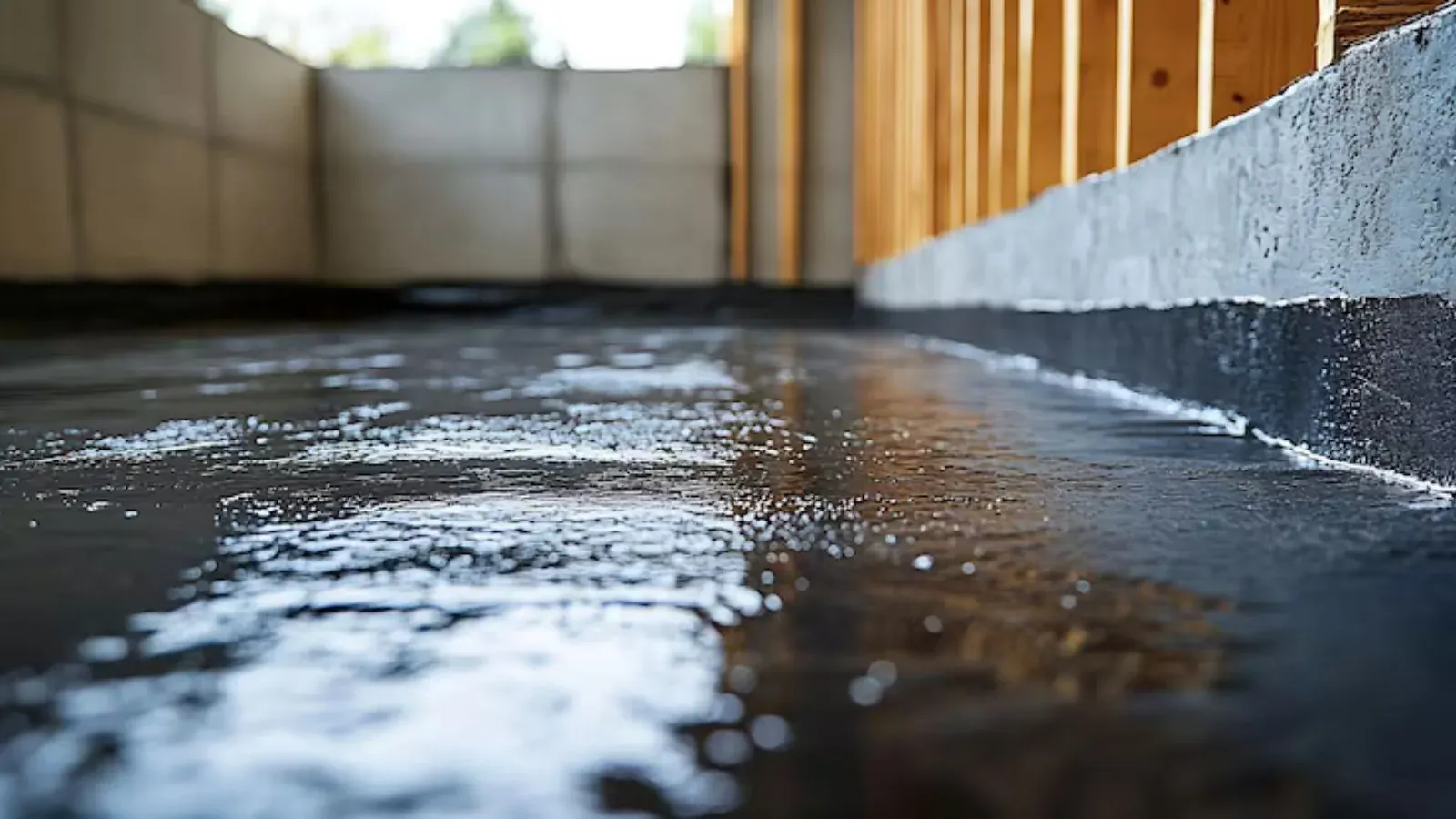
To waterproof a basement floor, you first have to decide whether you are blocking water or draining it. A paint-on coating blocks moisture vapor and small seepage, but it fails against real water pressure from the soil. Floors that stay wet after storms usually need interior drain tile and a sump pump, so the water has somewhere to go.
This guide walks through how to test your floor, which fixes suit which problem and what Morton Grove homeowners should check about floor drains and sewer backup before spending money on any coating.
Start by finding out where the water comes from
Water on a basement floor has only a few sources, and each one needs a different fix. Treating the wrong one wastes a weekend and a lot of product. Spend a day or two on diagnosis before you buy anything.
The cheapest test uses a square of plastic sheet. Tape an 18-inch piece flat to the bare concrete on all four sides with duct tape, leave it for 48 hours, then look. Moisture on the underside of the plastic means water vapor is rising through the slab. Moisture on top of the plastic means condensation from damp indoor air. Water pooling around the edges means liquid water is coming up at the joints.
Signs your floor needs more than a coating
- Water appears at the wall and floor joint after heavy rain.
- A dark, damp line follows cracks in the slab.
- Puddles form near the floor drain or sump pit.
- Efflorescence, a white powdery crust, builds up on the concrete.
- Paint or old coatings bubble and peel off in sheets.
- The basement smells musty even when the dehumidifier runs.
If the plastic test shows only light vapor, a quality masonry sealer and better ventilation may be enough. If water pools or the crack weeps, move on to drainage.
Hydrostatic pressure: why coatings let go
Soil around a foundation holds water after rain. That water presses on the slab from below and the walls from the side, and the force is called hydrostatic pressure. A thin coating cannot resist it. The water pushes through the weakest spot or lifts the coating off the concrete.
This is why a floor can look dry for one season and then fail after a spring storm. The coating did not leak, it was simply overpowered. Systems that last do not fight the pressure. They relieve it by giving water a path to a pit, and the pump moves it outside the house.
Fix options compared
Here is how the common fixes compare. Costs are not listed because they depend on floor area, access and what is under the slab.
| Fix | Handles | Does not handle | Disruption |
|---|---|---|---|
| Concrete sealer or epoxy coating | Vapor and damp concrete | Standing water, cracks that move | Low, a weekend |
| Crack injection (epoxy or polyurethane) | A single stable crack | Many cracks, rising water table | Low to moderate |
| Interior drain tile with sump pit | Groundwater under and beside the slab | Sewer backup through floor drains | High, floor is cut and re-poured |
| Sump pump with battery backup | Collected groundwater | Pump failure with no backup power | Moderate |
| Backwater valve on the floor drain | Sewage backing up through the drain | Groundwater seepage | Moderate |
Notice that no single fix covers every row. A wet floor after a storm may have two causes at once, such as groundwater through a crack and sewage rising through a drain.
Cracks, and which ones matter
Hairline shrinkage cracks are normal in slabs and often stay dry. A crack that is wider than a credit card, has one side higher than the other, or leaks after rain deserves attention. Injecting a crack stops that point of entry, but if the water table is high, new cracks may appear nearby. A repair that does not address the water source is only a delay.
Interior drain tile and the sump pit
Interior drain tile is a perforated pipe set in gravel around the inside edge of the footing. A plumber or waterproofing crew cuts a channel in the slab, lays the pipe, and routes it to a sump pit. When water rises in the pit, the pump switches on and sends it out through a discharge line. The channel is then patched with new concrete.
It is a bigger job than a coating, but it manages water instead of masking it. The sump pump is the part that fails most often, so ask about a backup and a check valve on the discharge line. You can read more about options on our basement waterproofing page, and sump sizing and replacement are covered under sump pump installation and repair.
The floor drain: the weak spot many homeowners miss
A floor drain connects to the sewer. In a storm, when the sewer fills, water and waste can back up through that drain into the basement. Waterproofing the slab will not stop it. If the water on your floor smells like sewage, looks gray or black, or comes up through the drain, treat it as a sewer problem.
Avoid contact with the water, keep children and pets away, and do not run water in the house. Call a licensed plumber to check the line. A backwater valve or an overhead sewer conversion is the fix, and the cost depends on how your home is plumbed.
While you wait for help with a flooded basement
- Do not walk through standing water if the electrical panel or outlets may be wet. Keep away from them.
- Switch off the breaker only when the ground around the panel is dry and the switch is easy to reach.
- Keep out of any water that smells like sewage. It carries bacteria.
- Stop using sinks, tubs and washers so less water enters the drain.
- Move belongings up off the floor if you can do it safely.
A practical order of work
If your basement floor is damp or occasionally wet, this sequence avoids wasted effort. Plenty of owners start with the coating and finish with a drain tile system two years later.
- Fix the outside first. Extend downspouts several feet from the foundation and grade soil away from the walls.
- Run the plastic sheet test for 48 hours to separate vapor from liquid water.
- Test the sump pump if you have one by pouring a bucket of water into the pit.
- Have a plumber check the floor drain and the lateral for backups.
- Choose between crack injection, a coating, or interior drainage based on what you found.
- Only then, apply a floor sealer or finish, because trapped moisture ruins most coatings.
Water on the floor after every storm?
A licensed plumber can trace the source before you spend on a coating.
What drives the price of waterproofing a basement floor
No honest price can be given without seeing the floor, and we do not list dollar figures here. These are the factors that move it.
What moves the cost of a basement floor fix
- Linear feet of drain tile: A full perimeter costs far more than one wall, and the slab must be cut and patched along the route.
- Sump pit and pump quality: Pump size, a battery backup and a sealed lid add to the total.
- Discharge route: A long run to a safe outlet adds pipe and labor.
- Floor drain and sewer work: A backwater valve or overhead sewer is a separate scope from drainage.
- Finish after the work: New concrete, flooring and wall repair are extra trades.
Homeowners insurance usually excludes groundwater seepage and may cover sewer backup only with an endorsement. Read your policy before a storm, not after.
Want your real number? Call (847) 281-8626.
Morton Grove flooding and old sewers
Morton Grove note
The Cook County hazard plan lists street and basement flooding in Morton Grove, including events on 13 September 2006 (4.44 inches of rain) and 22 July 2011 (4.25 inches). It names flood-prone areas that include the National Park and Emerson/Capri neighborhoods. That does not mean every home there floods, but it does mean those blocks have a record worth knowing about when you buy or fix a basement.
Homes built before 1965 often rely on gravity sewer connections. In heavy, extended rain those can back up into the basement. If your home predates 1965, a floor coating alone cannot address that risk, so ask a plumber about the drain and the sewer connection too.
Source type: Morton Grove flood history from the county hazard plan, plus the village sewer assistance page
Neighbors and nearby towns
The same logic applies in neighboring communities. If you are weighing options in Glenview, the soil, the water table and the age of the sewers will differ, so the diagnosis steps matter even more. Homeowners in Park Ridge face similar choices between coating, drainage and a backwater valve. Each house is its own case.
Questions about waterproofing a basement floor
Frequently asked questions
Waterproof paint helps with vapor and light dampness on sound concrete. It will not stop water pressing up from the soil. If the plastic test shows moisture on the bottom, or the floor gets wet after rain, plan for drainage.
Leave it taped down for about 48 hours. Moisture under the sheet points to vapor rising through the slab. Moisture on top points to humid indoor air.
No. Drain tile handles groundwater. Sewage backing up through a floor drain needs a backwater valve or an overhead sewer conversion, and a plumber should check the line.
The Cook County hazard plan lists the National Park and Emerson/Capri neighborhoods among flood-prone spots, along with some Dempster Street stretches. If you are unsure, ask Public Works about flooding history near your address.
Floors flood at night as often as by day, so the phone is answered around the clock. A same-day appointment may open up depending on the schedule. If the water carries sewage or touches electrics, treat it as an emergency, call right away and stay out of it.