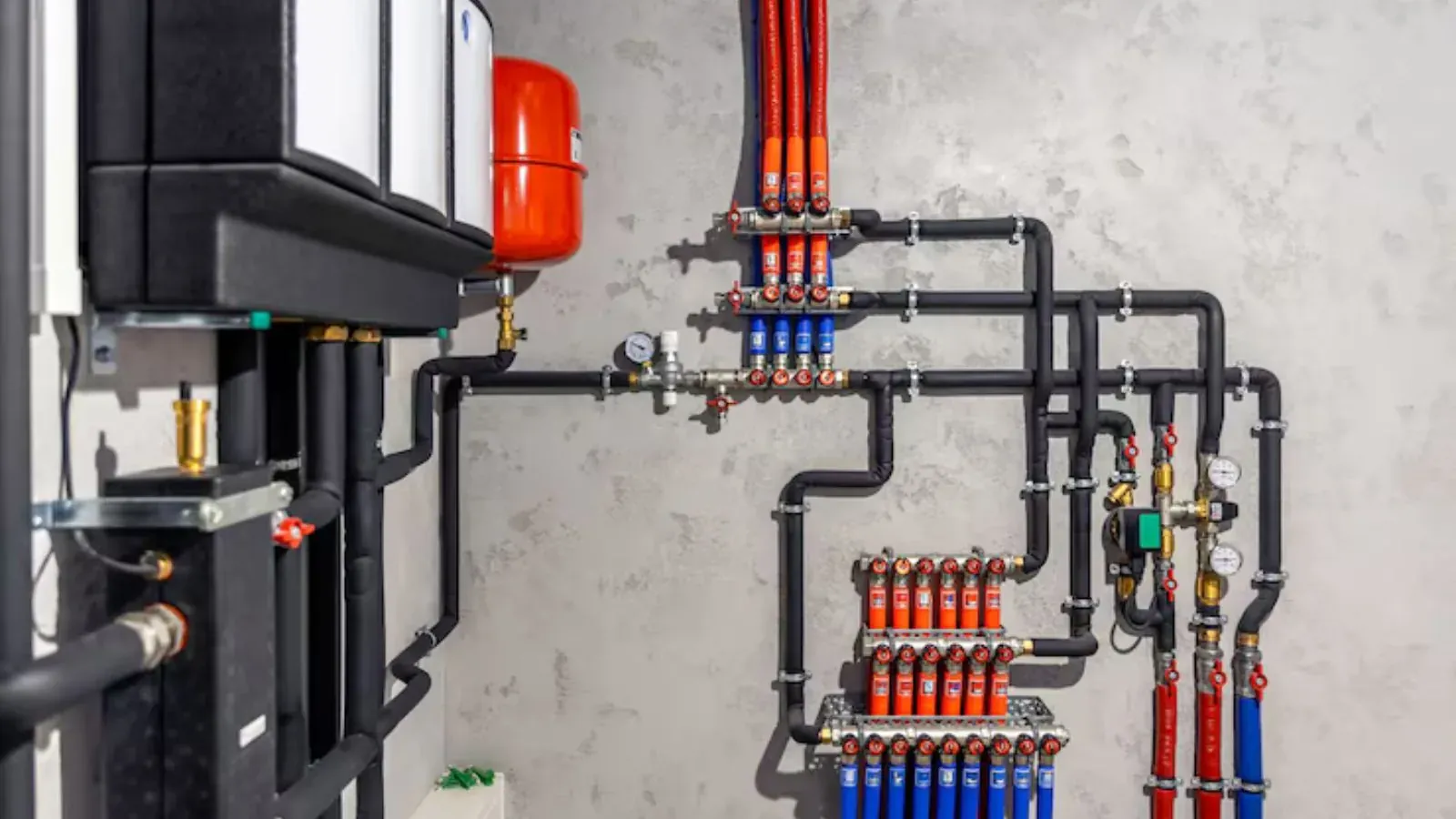
A boiler leak repair starts with one question: where is the water coming from? A boiler heats water and sends it through pipes or radiators, so a leak can come from the relief valve, a pump flange, the expansion tank, a pipe fitting or the heat exchanger inside the boiler. The first four are often repairable. A leaking heat exchanger usually means the boiler is near the end of its life.
If you smell gas, leave the house and call 911 and the gas utility before anything else. Otherwise, this guide helps you read the leak, protect the floor and know when to stop and call.
Safety first: gas, carbon monoxide and hot water
Most residential boilers burn natural gas, and a leak near a burner is more than a plumbing problem. Treat these signs as an emergency and do not try to fix them yourself.
If you smell gas or suspect carbon monoxide
- Leave the building right away. Do not turn lights or switches on or off.
- From outside, call 911, then the emergency line listed on your gas bill.
- Do not go back inside until the fire department or the utility says it is safe.
- A carbon monoxide alarm that sounds means the same thing. Get everyone outside into fresh air.
- Do not touch a boiler that is hissing, steaming heavily or too hot to approach.
If the leak is only water and you smell nothing unusual, you can take a few safe steps. Switch the boiler off at its service switch, close the water feed valve if you can reach it, and put a pan or towels under the drip. Keep pets and children away from hot pipes. If the water is spreading toward electrical outlets or the panel, stay clear.
Where boilers leak, from simple to serious
Different parts leak for different reasons. Reading the location tells you a great deal about the repair.
| Leak point | What it looks like | Common cause | Repair outlook |
|---|---|---|---|
| Pressure relief valve | Drip or spray from a discharge pipe | Pressure too high, or a worn valve seat | Often a quick part swap |
| Circulator pump flange | Drip at the pump where it meets the pipe | Worn gasket or flange bolts | Usually repairable |
| Expansion tank | Water at the tank, or pressure that keeps climbing | Waterlogged or failed bladder | Tank replacement |
| Pipe fitting or valve | Slow drip, green crust on copper | Aging joint, corrosion | Repairable if limited |
| Heat exchanger | Water inside the boiler, rust streaks, odd noises | Corrosion or cracks | Often means replacement |
A single dripping joint is a small repair. Several leaks at once, or a boiler with rust running down its jacket, point to a system that is wearing out as a whole.
The relief valve: a safety device that is doing its job
If water is dripping from the relief valve pipe, resist the urge to cap it. This valve exists to release pressure before the boiler is damaged. A drip may mean pressure is climbing because the expansion tank has failed, or that the valve itself has a worn seat. Plugging it can create a dangerous situation.
Watch the pressure gauge. Most home boilers run in a modest pressure band when cold and rise when hot. If the needle climbs well above normal each cycle, the tank is the likely culprit, not the valve.
Circulator flanges and fittings
The circulator pump moves hot water through the loop. It bolts to the pipe with flanges and gaskets, and those gaskets harden with years of heat. A drip here often leaves a wet ring around the pump. A plumber can drain the loop, swap the gaskets and refill. It is a contained job when the pump itself is still working.
Pipe fittings tell a different story. Green or white crust is a sign of a slow weep. Tightening may stop it for a while, but if the pipe wall has thinned, a section should be replaced.
The heat exchanger
The heat exchanger is the part that transfers flame heat to the water. When it cracks or corrodes through, water leaks into the combustion area. That can cause rust, soot and unsafe exhaust, and it is not a repair to attempt. Many such boilers are replaced. A plumber can tell you honestly whether the rest of the system is worth saving.
What you can check, and what to leave alone
A few checks are safe and useful. Others belong to a licensed plumber.
Safe things a homeowner can look at
- The pressure gauge reading, compared with what your manual says is normal.
- Whether the leak is wet or only a damp, old stain.
- The color of the water. Rusty water points to corrosion inside the system.
- Whether radiators or baseboards are cold in spots, which can mean trapped air.
- The relief valve discharge pipe for drips, without touching the valve.
Leave gas valves, burner parts, flue pipes and the heat exchanger alone. Do not add water repeatedly to keep the pressure up, because fresh water brings in oxygen and speeds corrosion. If you are topping up often, the system is losing water somewhere. To see how hidden leaks are located behind walls or under floors, read about leak detection and the methods used for pipes you cannot see.
Why winter makes a small leak a bigger problem
A slow drip in October can turn into a cold house in January. When a boiler runs hard all day, every weak joint is tested. Cook County winters also bring freezing temperatures that stress pipes in unheated spaces such as garages and crawlspaces.
Have a small leak looked at before the cold arrives. A repair on a mild day is calmer and usually less expensive than a late-night call when the system has locked out and the house is dropping in temperature.
Boiler leaking in cold weather?
A licensed plumber can find the source and check the system for safe operation.
Repair or replace: how plumbers decide
The decision usually comes down to age, the number of leaks and the safety of the combustion side. Expect a plumber to look at the boiler jacket for rust, check the pressure behavior, and inspect the venting. That is a normal sequence for boiler repair work.
If the leak is at a relief valve, pump flange or a fitting, and the boiler is otherwise sound, repair is the sensible path. If the heat exchanger has failed, or repairs are stacking up, replacement is often the better value. Ask for the reasoning in plain words, and get the choice laid out with the cost factors before work starts.
What shapes the cost of a boiler leak repair
We do not publish dollar amounts here, because the part that failed decides the price. These are the factors that move it.
Factors that move a boiler leak repair price
- Which part failed: A gasket or relief valve is a small repair. A circulator or expansion tank costs more, and a heat exchanger usually means a new boiler.
- Boiler type and age: Parts for older boilers can be harder to find.
- Access: A boiler in a tight closet or crawlspace takes more time.
- System draining and refilling: Large systems with many radiators take longer to drain, refill and bleed.
- Time of day: a midnight call in a cold snap is handled differently from a booked daytime visit.
A homeowners policy might pay for water damage after a sudden leak. It seldom covers the worn boiler part itself, and slow leaks are often excluded.
Want your real number? Call (847) 281-8626.
Morton Grove gas, codes and permits
Morton Grove note
Natural gas here comes from Nicor Gas. A gas-fired boiler that smells of gas means you walk out first. Once outside, call 911 and the emergency number printed on your gas bill, and do not search for that number while you are still indoors.
Morton Grove follows the 2018 International Mechanical Code, with local amendments. The village requires permits for furnaces and water heaters, but its page says nothing about boilers. Phone the building office at (847) 470-5214 and describe your repair or replacement, then ask whether it needs a permit.
Source type: village building permit and mechanical code listings
Serving nearby homes
Boiler problems do not respect village lines. Our plumbers also handle heating leaks in Lincolnwood, just southeast of the village. Homeowners in Skokie call with the same drips, pressure swings and noisy pipes. The diagnostic steps are the same wherever the boiler sits.
Boiler leak questions answered
Frequently asked questions
It can be. A gas smell, a carbon monoxide alarm, heavy steam or water near electrical parts is an emergency. A slow drip is urgent but usually not dangerous. Turn the boiler off and call a licensed plumber.
Pressure may be rising too high, often from a failed expansion tank, or the valve seat may be worn. Do not cap the pipe. Have a plumber check the pressure and the tank.
A very small weep at a joint may be tolerable for a short time, but check the pressure daily. Any leak near the burner or the heat exchanger means shut it off and call.
Furnaces and water heaters appear on the village permit list, but boilers do not. Call the building office at (847) 470-5214 and describe the job before work begins.
Boilers fail in the cold, often after dark, and calls are taken at all hours. A same-day visit can be arranged when the schedule permits, though no arrival time is promised. If gas is in the air, leave the house and call 911 first.
A water leak alone does not, but it can damage the combustion area or the vent and lead to unsafe exhaust. Keep working carbon monoxide alarms on every level of the home.